 how-to
How to Vet Security Guard Companies: A 2026 Guide
Table of Contents
- Why Vetting Security Guard Companies Matters
- Verify Guard Qualifications and Training Requirements
- Security Company Licensing and Insurance Requirements
- Questions to Ask Security Companies Before Hiring
- How to Compare Security Guard Quotes and Proposals
- Security Services Contract Checklist
- Red Flags and Warning Signs to Watch For
- Measuring Performance After Hiring
- Frequently Asked Questions
Last Updated: October 21, 2026
Why Vetting Security Guard Companies Matters
Hiring the wrong security provider exposes your property to real risks: a poorly trained guard, weak background screening, or missing insurance can turn a contract into a liability nightmare, theft, injury claims, regulatory violations, and lost trust.
This guide covers the qualifications to verify, the licensing and insurance that protect you legally, the questions that separate professional operators from mediocre ones, and the red flags that should stop you signing.
Verify Guard Qualifications and Training Requirements
Guard qualifications are where most facility managers make their first mistake: assuming anyone hired as a security officer has met a baseline standard. Standards vary dramatically by state, company, and type of work.
When you vet security guard companies, ask directly: What training do your guards receive before deployment? A legitimate provider should have a written program covering threat assessment, de-escalation, emergency response, and your property's protocols, with documentation, not just verbal description.
Check Training Certifications
Training certifications show whether guards have met recognized standards, and the ones that matter depend on your location and needs, some states require specific armed-guard certifications, others barely any.
Ask for evidence of completion, training records, dates, and topics covered. If a provider says "all our guards are trained" but can't produce documentation, that's a warning sign.
For armed security, federal and state certifications carry more weight. Your provider should explain which certifications their armed guards hold and why they matter for your needs.
Confirm Background Check Standards
Background checks are the foundation of guard vetting: criminal history, employment verification, and reference checks, with depth matched to the sensitivity of the work.
Ask your provider: Do you run FBI checks, state-level criminal checks, or both? How far back do you investigate employment history?
A company that cuts corners on background screening is cutting corners on your security. If they won't explain their process in detail, move on.
Security Company Licensing and Insurance Requirements
Licensing and insurance are legal requirements that protect you from liability. A company operating without proper licensing is operating illegally, and one without adequate coverage leaves you exposed to claims you should never have to pay.
When you vet security guard companies, licensing and insurance should be among your first checks. These are non-negotiable, and a copy proves nothing. Verify the underlying records yourself.
State Licensing Verification
Private security firms are licensed at the state level, and the regulator varies, a department of consumer affairs, public safety, a private security board, or a state police licensing division. Some states issue a company license plus separate guard registrations; others issue one firm license with endorsements for armed services, patrol, or alarm work.
How to verify, step by step:
- Ask the provider for their legal business name, license number, license type, and expiration date, in writing.
- Look up the regulator's public license database yourself. Do not rely on a PDF the provider sends you; PDFs are easy to alter.
- Confirm the license is active, not suspended or expired, and that the license type covers the services you are buying (armed vs. unarmed, contract guard vs. proprietary, patrol vs. standing post).
- Confirm the license is issued to the same legal entity that will sign your contract. A common red flag is a licensed sales entity paired with an unlicensed operating entity that actually staffs your site.
- Ask whether the guards assigned to your site hold individual registrations or permits, and verify a sample of those too.
Insurance Coverage and Liability Protection
Insurance protects you if a guard causes injury or property damage or is accused of misconduct. Verify your provider carries adequate coverage and names you as an additional insured.
Ask for a certificate of insurance (COI) before signing. It should show:
- Commercial general liability, policy number, effective dates, and per-occurrence and aggregate limits.
- Workers' compensation, required in nearly every state, and proof that guards are classified as employees rather than misclassified contractors.
- Professional liability or errors and omissions, increasingly requested for guard forces that document incidents, use force, or handle access control.
Verify the COI directly with the issuing carrier or broker using the policy number. Certificates are frequently forged or outdated, and a call or email to the broker takes minutes.
What to Put in the Contract
Put licensing and insurance in the agreement, not a handshake. Include:
- A representation that the provider holds all required state and local licenses and will maintain them for the contract term.
- A requirement to notify you within a set number of days if a license lapses, is suspended, or is revoked.
- Minimum insurance limits, the additional insured requirement, and updated certificates at renewal.
If a provider resists putting these terms in writing, treat that as a signal about how they will handle a claim.
Questions to Ask Security Companies Before Hiring
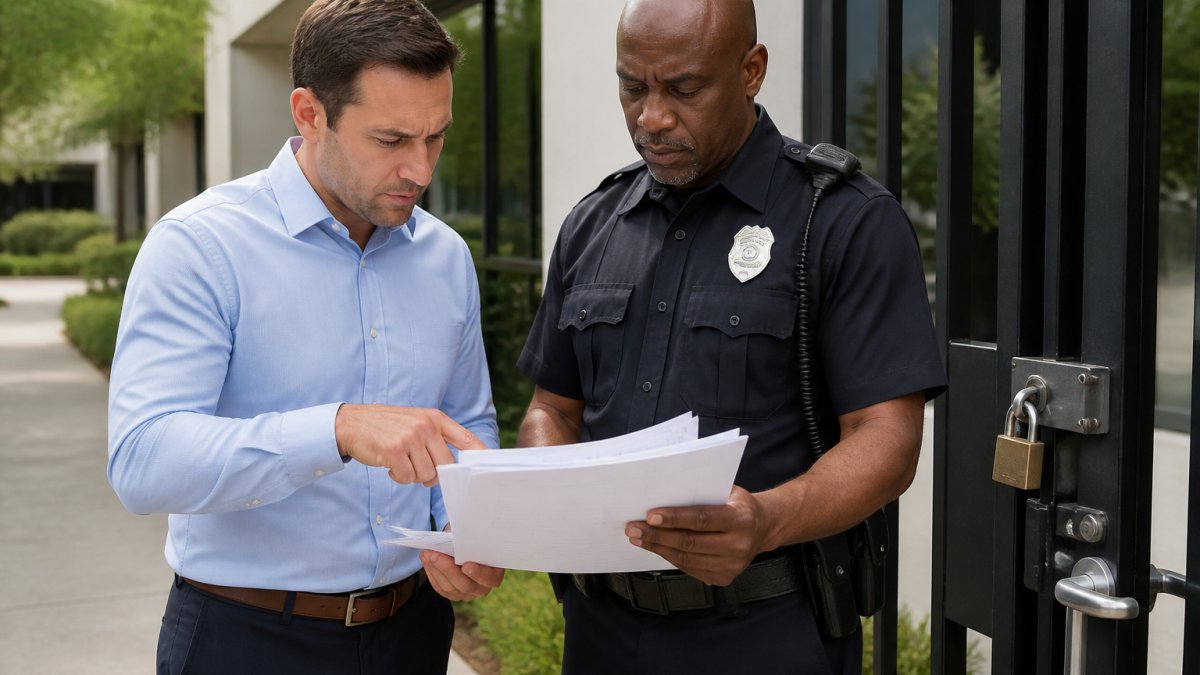
The right questions reveal how serious a security company is. Generic answers suggest a generic operator; specific, detailed answers suggest someone who understands your needs.
Most buyers ask the same five questions and get the same polished answers.
Operational and Staffing Questions
Start with how they staff your property. Ask:
- How do you build the schedule for a site like mine, and who approves overtime?
- What is your fill rate for open shifts, and your average time to fill a call-off?
- Do you maintain a bench of trained guards who can cover a same-day absence, or do you pull from another site?
Listen for specifics: a fill rate, a time-to-fill figure, a named backup pool, a discipline process. Vague answers ("we always cover") are a warning sign.
Training and Screening Questions
Ask what happens before a guard ever arrives at your site:
- What does your pre-assignment training cover, and how many hours is it?
- Which background checks do you run, and how far back do they go?
- Do you run drug testing at hire and randomly thereafter?
A provider that cannot describe its training curriculum in modules or hours is likely providing minimal training.
Reporting and Communication Questions
This addresses facility managers' most common complaint: not knowing what happens on their property at night.
- What does a daily activity report look like, and can I see a redacted sample?
- Which incidents trigger an immediate call to me, and which wait for the written report?
- Who is my after-hours contact, and what is the escalation path if that person does not answer?
Ask for a sample report. The quality of the written record tells you more than any sales pitch.
Performance and Accountability Questions
- How do you measure guard performance, and what metrics do you report to clients?
- What happens when a guard receives a complaint or fails a post order?
- Do you conduct supervisory site visits, and how often?
Contract and Cost Questions
- What is the all-in hourly rate, and what is excluded from it?
- What are your overtime, holiday, and short-notice cancellation rates?
- What is the minimum number of hours per shift or per week?
Red Flags in the Answers
Watch for these patterns:
- Answers that describe capabilities but never produce documents.
- Reluctance to name a fill rate, turnover figure, or time-to-fill.
- No sample report, or a sample that is a single line per shift.
- No named after-hours contact or escalation path.
A professional operator will ask you as many questions as you ask them. A provider that treats your site as a commodity will not.
How to Compare Security Guard Quotes and Proposals
When you vet security guard companies, compare beyond the price per hour, two providers quoting the same rate may offer completely different service levels.
Request detailed proposals from at least three providers, each specifying:
- Number of guards and shift coverage
- Guard qualifications and training
- Specific services (patrol frequency, access control, incident response)
- Reporting and communication protocols
Compare proposals side by side for service scope, not just price, the cheapest option is rarely the best when security is at stake.
| Comparison Factor | What to Look For | Red Flag |
|---|---|---|
| Guard qualifications | Documented training certifications | "Trained" with no proof |
| Licensing | Current state license with specific coverage type | No license or outdated license |
| Insurance | Certificate naming you as additional insured | No insurance or inadequate coverage |
| Reporting | Regular written incident reports | No formal reporting process |
| Customization | Site-specific security plan | One-size-fits-all package |
| Response time | Documented SLA for incident response | No defined response commitment |
Security Services Contract Checklist
Before signing, work through this checklist, each item protects you from unexpected costs, service gaps, or legal liability.
Review terms carefully: exact services, duration, renewal, and cancellation conditions. Look for:
- Clear definition of guard duties and responsibilities
- Response time commitments for incidents
- Your right to request specific guards or background checks on new personnel
- Procedures for handling complaints or performance issues
Verify that you're named as an additional insured on their liability policy, stated in the contract or confirmed separately in writing.
Clarify pricing: does the quoted rate include all costs, or are there additional charges?
Get everything in writing. Verbal agreements about service levels, response times, or special accommodations mean nothing in a dispute.
Red Flags and Warning Signs to Watch For
A company that won't provide documentation of guard training is hiding something.
A company that can't produce a current certificate of insurance is operating without adequate coverage, a legal risk you shouldn't accept.
A company that doesn't ask detailed questions about your property, needs, or risk profile is treating your security as a commodity.
A company that won't commit to specific response times or service levels in writing is leaving room to underperform.
Measuring Performance After Hiring
Vetting doesn't end at signing. Ongoing monitoring ensures your provider maintains the standards they promised.
Set clear metrics before guards arrive: incident response time, patrol frequency, incident documentation, guard attendance, and compliance with your protocols.
Request regular reports.
Schedule periodic site visits from your security company's management to assess guard performance and address concerns you've raised.
Don't wait for problems to surface. If a guard misses patrols, responds slowly, or ignores your protocols, raise it immediately.
Vetting security guard companies is work, but it protects your property, assets, and people, upfront verification prevents costly mistakes later. When you're ready for a security plan customized to your needs, get a free quote and let our team assess your property's actual requirements.
Frequently Asked Questions
How do I check whether a security guard company is licensed?
Request the company's Private Patrol Operator (PPO) license number and verify it directly with your state's licensing authority. Ask for proof of current licensing and any disciplinary records. Legitimate security companies display their license prominently and provide documentation without hesitation. Always cross-reference the license number independently rather than relying on company-provided verification.
What questions should I ask a security guard company before hiring?
Ask about guard training frequency, background check procedures, how they handle staffing turnover, incident reporting protocols, technology capabilities (like real-time monitoring), customization options for your specific needs, and their experience with facilities similar to yours. Request references from current clients in your industry. Inquire about their response time to incidents and what happens if a guard calls out sick.
What insurance should a security guard company carry?
Security companies must carry general liability insurance, workers' compensation coverage, and professional liability insurance. Ask for minimum coverage amounts (typically $1 million general liability) and request certificates of insurance naming your facility as an additional insured. Verify the insurance is active and covers the specific services they'll provide, especially for armed security or specialized deployments.
What are warning signs when hiring a security company?
Watch for companies that won't provide references, lack transparent licensing information, offer prices significantly below market rates, have high guard turnover, can't explain their background check process, or avoid discussing incident reporting. Be cautious of firms that pressure you into quick contracts, lack written service agreements, or can't demonstrate experience with your facility type or security challenges.