 how-to
7 Things to Look for in Security Reporting
Last Updated: November 1, 2026
Quick Summary
Security reporting is the written record of what a guard observed, did, and decided during a shift, captured in enough detail that a manager can act on it later. Look for reports that answer who, what, when, where, why, and how, separate observations from assumptions, include names and badge numbers, and carry a reviewer sign-off and unaltered edit history.
- Score each report against a ten-item checklist and send back any that fail three or more boxes.
- A strong daily activity report logs patrol rounds with timestamps, access control notes, anomalies, and handover notes.
- Reference evidence by exhibit name, store originals untouched, and note who has access.
- Track median incident-to-submission time, missing-field rate, and correction rate monthly.
- Request two or three redacted sample reports, one daily log and one incident report, before signing.
Table of Contents
- Why Security Reporting Quality Decides Whether You're Protected
- The Core Elements Every Report Must Contain: Who, What, When, Where, Why, How
- Your Security Incident Report Checklist for Evaluating Submissions
- What a Strong Security Guard Daily Activity Report Looks Like
- Security Incident Report Examples: Good vs. Weak Documentation
- Building a Security Reporting Template That Holds Up Under Review
- Objective Language, Review Standards, and Digital Audit Trails
- Request Sample Reports Before You Sign a Security Contract
- Frequently Asked Questions
Why Security Reporting Quality Decides Whether You're Protected
A security officer who spots a broken loading dock door at 2 a.m. and writes "all clear" has given you nothing.
The stakes are real. A weak report can sink an insurance claim, hide a pattern of break-ins, or leave your team exposed in a lawsuit.
For a deeper look at how communication quality ties into overall protection, see our guide on evaluating security guard company communication quality.
The Core Elements Every Report Must Contain: Who, What, When, Where, Why, How
Every solid security report answers six questions. Miss one and the document becomes a story, not evidence.
- Who: People involved, witnesses, the report writer
- What: The incident or observation, stated plainly
- When: Date and exact time, down to the minute
- Where: Specific location, not just "the building"
- Why: The likely cause or reason, if known
A report that skips "when" cannot support a timeline. One that skips "where" cannot help you fix a weak spot. These six elements are the backbone of any security incident report.
Identifying Details: Names, Badge Numbers, and Shift Boundaries
Names, badge numbers, and shift start and end times make a report traceable. The report writer's name and badge number let you follow up with the right officer. Shift boundaries show whether an event happened on their watch or the next one.
A common mistake is leaving out the badge number. Without it, you cannot link the report to a specific guard during an investigation.
Sequence of Events, Observations, and Actions Taken
Write the timeline in order. What did the officer see first? What did they do next? Who did they call?
Separate what was observed from what was assumed. "The gate was open" is an observation. "Someone forgot to lock it" is a guess. Keep them apart and the report holds up under review.
Your Security Incident Report Checklist for Evaluating Submissions
Use a security incident report checklist to grade any report quickly. Score each line yes or no.
- Date, time, and location are specific
- Report writer's name and badge number are present
- People involved and witnesses are named
- The sequence of events is in order
- Observations are separated from opinions
If a report fails three or more boxes, send it back for revision. A provider that resists revision is telling you something about its standards.
What a Strong Security Guard Daily Activity Report Looks Like
A strong security guard daily activity report reads like a log, not a diary. It records each patrol, check, and anomaly with times attached.
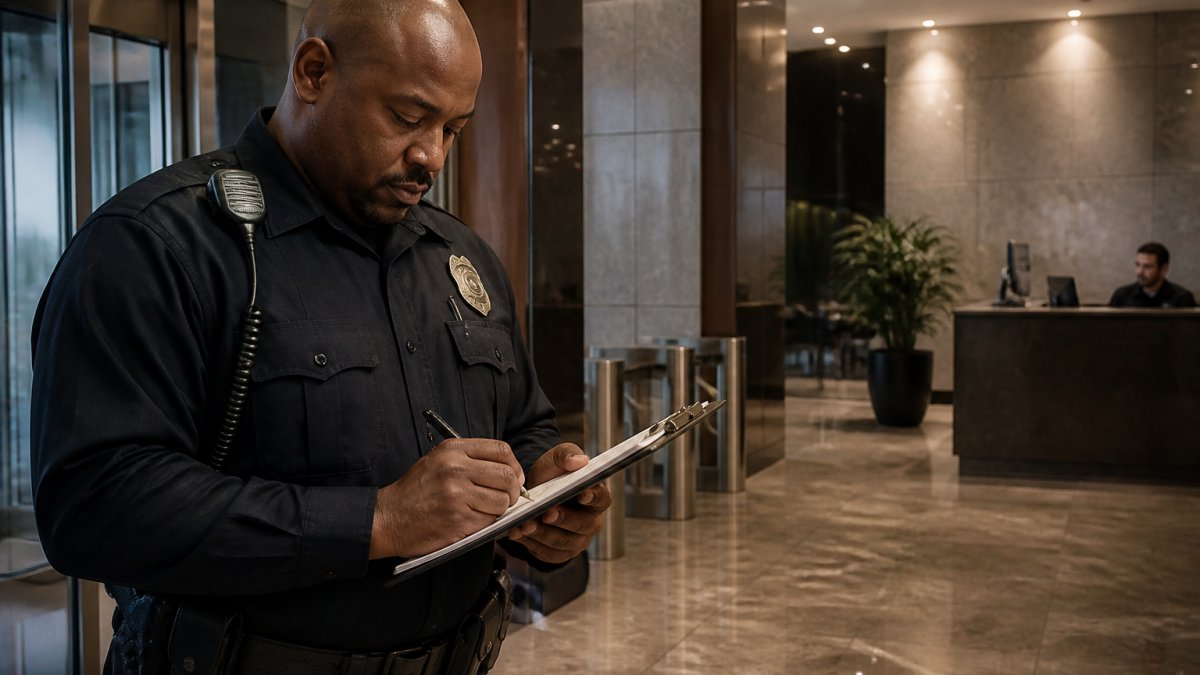
A useful daily log includes:
- Shift start and end times with the officer's name
- Patrol rounds with timestamps for each checkpoint
- Access control notes: who entered, when, and under what authority
- Anomalies: doors ajar, lights out, alarms triggered
- Fire hazard observations spotted during rounds
The daily report is where patterns hide. One flickering alarm at 3 a.m. means nothing. The same alarm three nights running is a trend worth investigating.
Security Incident Report Examples: Good vs. Weak Documentation
The difference between good and weak security incident report examples is usually detail and objectivity, not length.
Weak: "Heard a noise near the back. Checked it out. Nothing there. All fine."
Good: "At 02:14, heard metal scraping near rear loading dock.
The weak version tells you nothing you can act on.
Watch out: vague language like "suspicious activity" without specifics is the most common failure we see.
Building a Security Reporting Template That Holds Up Under Review
A security reporting template standardizes what every officer captures, so nothing gets skipped on a busy night. Build two templates: one for daily activity logs and one for incidents. Keep them short enough to complete under pressure but structured enough that a reviewer can find any field in seconds.
Your incident template should include these fields, with guidance on what "good" looks like in each:
| Field | What to Capture | What Weak Entries Look Like |
|---|---|---|
| Header | Date, time, location, report writer, badge number, report ID | Missing badge number or report ID, so the record cannot be traced |
| People involved | Names, roles, contact details, whether they are employees, visitors, or contractors | "A man" or "someone" with no role or affiliation |
| Witnesses | Names, statements, and whether the statement was direct observation or secondhand | "Witnesses say" with no names or attribution |
| Sequence of events | Timed, step-by-step account with clock times, not "later" or "after a while" | Narrative with no timestamps |
| Actions taken | Response, notifications, escalation, and who was contacted | "Handled it" with no detail |
| Evidence | Photos, video, documents referenced by file name or exhibit number | "Took pictures" with no reference |
| Cause | Known or suspected reason, clearly labeled as known or suspected | Speculation stated as fact |
| Sign-off | Writer, reviewer, revision notes, and approval timestamp | No reviewer line at all |
A filled-in example beats a blank form. Train officers on a completed sample so they see the expected level of detail. Here is an annotated example for a routine incident:
Report ID: INC-2026-0417 | Writer: J. Alvarez, Badge 214 | Shift: 22:00-06:00 When: 02:14 | Where: Rear loading dock, north bay What: Heard metal scraping; found dock door latch loose but door secured. Actions: Visual sweep at 02:16; notified shift supervisor at 02:20; logged for maintenance. Evidence: Photo EX-0417-01 (latch), stored in case folder. Cause: Suspected wear, not forced entry. Labeled suspected.
That example shows the level of specificity to expect: times, a badge number, an evidence reference, and a cause labeled as suspected rather than asserted.
Evidence Handling, Privacy, and Data Minimization
Reference evidence in the report, then store it securely. Note what was collected, where it is kept, and who has access.
Preserve originals. Do not crop, annotate, or overwrite the source file; work from a copy and keep the original untouched.
Collect only what you need. Names, contact details, and medical information are sensitive. Under privacy laws, keeping unnecessary personal data creates risk.
A template only holds up if it is trained, audited, and revised. Review completed reports against the template monthly and update the form when officers consistently leave a field blank or misinterpret it.
Objective Language, Review Standards, and Digital Audit Trails
Objective language keeps a report credible. Write "the door was unlocked" not "the guard was careless." Facts survive scrutiny; blame does not. The practical test is to separate three things on the page: what the officer directly observed, what someone else told the officer, and what the officer inferred.
- Direct observation: "Saw the east gate standing open at 23:41."
- Hearsay or report from another: "Tenant stated she saw a person near the gate at 23:30."
- Inference: "Possible attempted entry; no signs of forced entry observed."
Use neutral verbs and avoid conclusory adjectives. "Appeared agitated" is an inference; "raised his voice and paced" is an observation. When quoting a person, use exact words in quotation marks and attribute them.
A Review Checklist and Measurable Standards
Set review standards. A supervisor should read every incident report before it closes. Flag bias, speculation, and missing details. Log any revision so the record shows what changed and why. Use a short review checklist:
- Every claim is labeled as observation, statement, or inference
- No conclusory or blaming language
- Quotations are exact or marked as paraphrase
- All template fields are complete or marked "not applicable"
- Evidence references match stored files
Then measure the process, not just individual reports. Track a few simple metrics monthly: median incident-to-submission time, missing-field rate, correction rate after review, and the share of reports returned for revision. A rising correction rate can signal a training gap; a falling incident-to-submission time with a stable correction rate usually signals a healthier workflow.
Digital Audit Trails
Digital reporting workflows add an audit trail. Timestamped entries, secure logins, and edit history prove the report was not altered after the fact. That trail matters during an investigation or a compliance review. Look for systems that record who created, edited, and approved each report, preserve prior versions, and restrict deletion. Export a copy of the audit log when a report is used in an investigation so the trail travels with the record.
Request Sample Reports Before You Sign a Security Contract
Ask for sample reports before you sign anything. A provider's reporting quality shows up in its paperwork, not its sales pitch.
Read them against the checklist above. Look for timestamps, objective language, and evidence references.
Pair the samples with a broader due-diligence process. Our guide on how to vet security guard companies walks through the full evaluation.
Securify Security Services offers customizable security solutions and continuous performance evaluation, and conducts rigorous background checks on its officers.
Frequently Asked Questions
What should a security guard include in a daily activity report?
A daily activity report should log shift start and end times, the guard's name and badge number, patrol routes completed, access control checks, any anomalies or suspicious activity, and actions taken. Timestamps matter more than narrative length. The report should also note equipment checks, visitors logged, and any handoff notes for the next shift. A daily log with these elements gives property managers a clear record of what actually happened on site and supports trend analysis over time.
How quickly should a security guard report an incident?
Timely reporting matters for accuracy and liability. A verbal notification to the client and dispatch should happen immediately, while the written incident report should be completed before the end of the shift, while observations are fresh. Delays erode detail and invite questions about whether the guard acted promptly. Your reporting procedure should state a clear deadline, and the report writer should note the exact time the incident occurred versus the time it was documented.
What are common mistakes in security incident reports?
The most frequent problems are subjective language ('the subject seemed aggressive'), missing timestamps, vague locations ('near the back'), and skipped follow-up actions. Reports that blend opinion with observation weaken incident documentation and can complicate an investigation or insurance claim. Other common errors include missing witness names, no badge number or report writer identification, and gaps in the sequence of events. A security incident report checklist used during revision catches most of these before the report reaches the client.
How can you tell whether a security report is accurate and complete?
Check three things: whether every claim is tied to an observation or evidence, whether the who, what, when, where, why, and how are all answered, and whether the timeline has no unexplained gaps. A professional report uses factual language, identifies people involved with full names and roles, and separates what the guard saw from what they concluded. Ask for security incident report examples from the provider and compare them against your security reporting template before you commit to a contract.
Weak reporting leaves you blind to what happens on your property after hours. If you cannot trust the paperwork, you cannot trust the protection. Securify Security Services delivers detailed daily logs, clear incident documentation, and 24/7 oversight you can actually verify. Get a free quote and see what accountable security reporting looks like for your property.