 how-to
How to Maintain Guard Alertness During Night Shifts
Last Updated: October 23, 2026
Quick Summary
Maintain guard alertness during night shifts by protecting a consistent daytime sleep block, planning breaks around the 2 a.m. to 6 a.m. alertness dip, and using movement, patrol checklists, and well-timed caffeine. Front-load caffeine early in the shift, stop it at least six hours before sleep, and report unsafe fatigue for relief rather than pushing through it.
- Keep the same sleep block seven days a week, including days off, and make the room cool and dark.
- Take short movement breaks every 90 to 120 minutes instead of one long break.
- Stop all caffeine at least six hours before your planned sleep block.
- Cap caffeine at roughly 200 to 300 mg, about two to three standard servings.
- Report fatigue early using a clear escalation path so relief can be arranged.
Table of Contents
- Why Night Shift Alertness Fails and How to Set Up the Shift
- Build a Night Shift Sleep Schedule That Protects Daytime Sleep
- Design a Night Shift Break Schedule Around the Alertness Dip
- Use a Night Patrol Checklist to Keep Movement and Checkpoints on Track
- Run a Night Shift Handoff Checklist to Close Alertness Gaps
- Manage Caffeine, Meals, and Hydration for Sustained Guard Alertness
- Escalate Fatigue Risk and Measure Alertness Across the Security Post
- Conclusion
- Frequently Asked Questions
Why Night Shift Alertness Fails and How to Set Up the Shift
Guard alertness is the ability to stay awake, aware, and ready to respond through an entire shift, and it fails on nights for one main reason: the body's internal clock fights the schedule.
The setup starts before the shift does. A guard who arrives already behind on sleep cannot fix it with willpower at 3 a.m.
Three things set the shift up for success:
- Sleep first. Protect the daytime sleep block like an appointment.
- Plan the night. Know where the alertness dip will hit and what you'll do about it.
- Use the post. Movement, light, and tasks are tools, not filler.
The National Institute for Occupational Safety and Health has long studied shift work and fatigue, and its guidance points to the same conclusion: fatigue is a workplace hazard to manage, not a personal weakness.
Build a Night Shift Sleep Schedule That Protects Daytime Sleep
A night shift sleep schedule works when it is consistent, protected, and dark. The goal is to sleep at the same time every day, including days off, so the body stops resetting itself.
Many guards make the mistake of flipping to a daytime schedule on their days off. That one choice undoes a week of adjustment.
Here is how to build the routine:
- Pick a fixed sleep block. Choose hours you can keep seven days a week, such as 8 a.m. to 3 p.m.
- Wind down before bed. Give yourself 30 to 60 minutes of low light and no screens.
- Keep the room cool and dark. Blackout shades and a cool room help the body settle.
- Use earplugs or white noise. Daytime noise is the enemy of daytime sleep.
- Avoid heavy meals right before sleep. Eat your main meal earlier in the wind-down.
Design a Night Shift Break Schedule Around the Alertness Dip
A night shift break schedule should place the longest rest near the alertness dip, which for most people lands in the early morning hours.
The alertness dip is real. It is the stretch when the body's clock says sleep, and it hits hardest between roughly 2 a.m. and 6 a.m. for many night workers.
Plan breaks like this:
- Short breaks every 90 to 120 minutes. Five to ten minutes of movement beats one long break.
- Longer meal break before the dip. Eat before the hardest hours, not during them.
- Move during every break. Stand up, walk the perimeter, stretch. Do not sit.
A break schedule only works if the post can actually cover it.
Use a Night Patrol Checklist to Keep Movement and Checkpoints on Track
A night patrol checklist turns movement into a routine. It lists the checkpoints, the order, and the timing, so a guard does not have to decide what to do when tired.
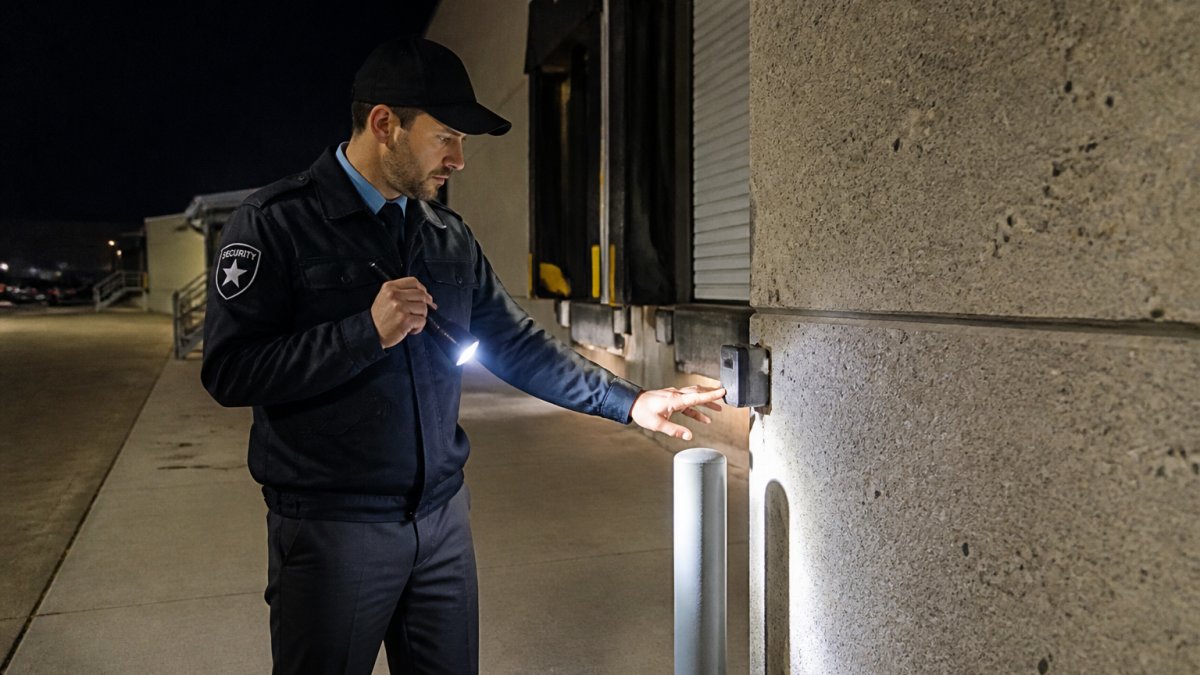
Movement is one of the strongest tools against fatigue. A guard who sits for four straight hours will feel the dip far harder than one who walks a route.
A simple patrol checklist covers:
- Checkpoint list. Every door, gate, and camera blind spot, in order.
- Timing. How long each leg should take, so a slow or skipped route is visible.
- Movement breaks. A short walk between checkpoints, even on quiet nights.
Run a Night Shift Handoff Checklist to Close Alertness Gaps
A night shift handoff checklist moves information from the outgoing guard to the incoming one so nothing gets lost.
The handoff is where details disappear. A guard who is tired and ready to leave will rush it unless there is a checklist.
Cover these items every time:
- Open incidents and unresolved issues. What happened, what was done, what still needs attention.
- Equipment status. Radios, flashlights, keys, and cameras checked and working.
- Access changes. New visitors, deliveries, or vendors expected during the next shift.
- Fatigue notes. If the outgoing guard was struggling, say so. Hiding it puts the next guard at risk.
- Signed acknowledgment. Both guards confirm the handoff.
This is also where guard accountability lives. A written handoff creates a record, and a record changes behavior.
Manage Caffeine, Meals, and Hydration for Sustained Guard Alertness
Caffeine is the most-used alertness tool on night shifts, and it is also the most misused. The difference between help and harm is timing, dose, and what you do when caffeine stops working.
Caffeine blocks adenosine, the chemical that builds sleep pressure. It does not remove fatigue; it hides it for a while. That matters on a security post because hidden fatigue can fail suddenly during a patrol or an access-control check.
Use these guard-specific guidelines:
- Front-load caffeine, then taper. Have your largest serving in the first third of the shift. If you need a second, take it before the midpoint. Stop all caffeine at least six hours before your planned sleep block. For a guard sleeping from 8 a.m. to 3 p.m., that means no coffee after roughly 2 a.m.
- Cap the total. Two to three standard servings (about 200 to 300 mg of caffeine) is a reasonable ceiling for most healthy adults. Energy drinks often contain more than one serving per can, so read the label rather than counting cans.
- Pair caffeine with a short nap when the post allows it. A 15- to 20-minute nap before caffeine takes effect can sharpen alertness more than either alone. This only works on posts with permitted break coverage and a safe place to rest.
A simple rule for the post: caffeine early, water all night, food before the dip, and nothing that keeps working after you clock out.
Escalate Fatigue Risk and Measure Alertness Across the Security Post
Fatigue risk should be assessed and escalated, not left to individual judgment. A guard who is too tired to stay sharp needs a clear path to report it without penalty, and supervisors need a defined response.
Supervisors and employers carry real responsibility here. The Occupational Safety and Health Administration frames fatigue as a workplace hazard that employers should address through scheduling, training, and reporting systems.
Recognize unsafe fatigue before it becomes an incident
A guard who is merely tired can usually finish a shift with movement, breaks, and caffeine. A guard who is unsafe to continue shows different signs. Watch for:
- Microsleeps or nodding off at a static post, in a vehicle, or during a monitor check.
- Missed or late checkpoints that the guard cannot explain.
- Slow or confused response to a radio call or a routine question.
These are fatigue indicators, not discipline problems. Treating them as discipline problems is how guards learn to hide fatigue until something goes wrong.
Follow a clear escalation path
Build escalation into the post so no one has to improvise at 3 a.m.:
- Self-report. A guard can flag fatigue to the supervisor without fear of discipline. Use a simple phrase on the radio or in person, such as "I need a fatigue check."
- Supervisor check-in. The supervisor responds with a scheduled radio or in-person check during the dip window, confirms the guard's status, and decides whether relief is needed.
- Relief options. Have a plan for swapping or covering a post when a guard is unsafe to continue. This may mean a relief officer, a shortened patrol route, or a paired assignment for the rest of the shift.
- Documentation. Log the fatigue report, the response, and any relief provided. This protects the guard and gives the employer a record for scheduling review.
- Incident review. Any near-miss or gap gets reviewed for fatigue as a cause, not just as a guard error.
Measure alertness with post-level indicators
Measuring alertness is not about surveillance. It is about pattern-finding. Use indicators that already exist in security operations:
- Missed or late patrol checkpoints logged by time-stamped entries.
- Response times to radio calls, alarms, and access requests.
- Incident and near-miss reports during the dip window.
Look for patterns by shift, post, and time of night. A cluster of missed checkpoints between 3 a.m. and 5 a.m. on a static post is a scheduling or task-design signal, not proof that one guard is careless.
Tailor the response to the post
Different posts carry different fatigue risks and different options for relief:
- Static posts offer limited movement, so scheduled walking breaks and task rotation matter most.
- Vehicle patrols carry a higher risk of microsleeps behind the wheel; pair driving with planned stops and radio check-ins.
- Access control requires sustained attention at a single point; rotate with patrol or lobby checks when staffing allows.
At Securify Security Services, our officers go through rigorous background checks and intensive training, and we run continuous performance evaluation. That structure exists so alertness is checked, not assumed. If you want to see how a customized plan would look for your property, get a free quote and we will walk you through it.
Conclusion
Night shift alertness is a system, not a personality trait. The guards who stay sharp are the ones whose sleep, breaks, patrols, and caffeine are planned before the shift starts.
If your property needs a security presence that holds up at 3 a.m. and not just on paper, Securify Security Services can help. Our team provides armed, unarmed, and vehicle patrol services with customizable solutions, 24/7 support, and continuous performance evaluation.
Frequently Asked Questions
How often should security guards take breaks during a night shift?
Plan breaks in shorter, more frequent blocks rather than one long meal break. A 10 to 15 minute break every 90 to 120 minutes keeps movement and alertness steadier than a single 45 minute pause. Place one break just before the expected alertness dip in the early morning hours. The night shift break schedule should also rotate post coverage so no checkpoint is left unwatched. Document break times in the daily activity report so supervisors can confirm coverage held.
What can I take to stay awake on night shift?
Caffeine is the most practical option, but timing matters more than dose. A cup of coffee or tea early in the shift helps, while caffeine within six hours of the end of shift can interfere with daytime sleep. Avoid energy drinks that stack large doses with sugar. Hydration and a light protein snack also support guard alertness better than heavy meals. If a guard feels too tired to work safely, the correct step is to report it to the supervisor, not to self-medicate with more stimulants.
How can security guards stay alert during night shifts?
Combine four habits: a consistent night shift sleep schedule with a dark, cool, quiet bedroom; a break schedule that includes standing and walking; a night patrol checklist that varies tasks and checkpoints; and a structured handoff that flags fatigue risks. Caffeine early in the shift and light meals help. Supervisors should also review incident reports and patrol logs for signs of reduced guard alertness. Securify Security Services builds these routines into every post and evaluates performance continuously.
What should a security guard do if they feel too tired to work safely?
Report it immediately to the shift supervisor and request relief or a reassignment to an active post. Do not continue driving a patrol vehicle or handling access control while impaired by fatigue. The supervisor should log the event, adjust the night shift break schedule, and check whether the guard's night shift sleep schedule is working. Repeated fatigue reports signal a scheduling or staffing problem that needs correction, not a discipline issue.