 ultimate-guide
Are Armed Dispensary Guards Required in California?
Quick Summary
Yes, armed dispensary security guard requirements in California include a valid BSIS Guard Card and an exposed firearm permit for every armed officer, plus a BSIS-licensed security company. Each credential must stay valid while the officer is armed on site, and armed coverage sits behind access control rather than replacing it.
- Every armed officer must hold a valid Guard Card and an exposed firearm permit issued through BSIS.
- The security company itself must hold its own BSIS license before placing any officer on the property.
- Start Live Scan fingerprinting early, since processing time is often the longest delay in licensing.
- Verify the exposed firearm permit directly, because an expired or missing permit turns an armed post into an unlicensed one.
- Review your property and business insurance for security-related conditions before finalizing a security contract.
Table of Contents
- California Guard Card Requirements for Armed Dispensary Staff
- How the BSIS Licensing Procedure Works
- California BSIS Exposed Firearm Permit: Application Steps
- California Armed Security Guard License Requirements Explained
- Armed vs. Unarmed Security Guard for Dispensaries
- Dispensary Security Hiring Checklist and Insurance Considerations
- Booking Armed Coverage for Your Dispensary
- Frequently Asked Questions
Are Armed Dispensary Guards Required in California?
Last Updated: October 28, 2026
California Guard Card Requirements for Armed Dispensary Staff
Meeting armed security guard requirements in California at a dispensary is not a box you check by hiring anyone with a gun. Understanding the requirements before you post a job or sign a contract can help you plan.
Age and Background Check Prerequisites
A common mistake is hiring a strong candidate before confirming their background is clear. Verify eligibility first, an officer rejected by BSIS after hiring costs you weeks of uncovered shifts.
Live Scan Fingerprinting Explained
Plan for this step early, processing time varies and can be the longest single delay in the licensing sequence.
How the BSIS Licensing Procedure Works
Your security company must hold its own BSIS license before placing any officer on your property. Ask for the license number and verify it directly on the BSIS website, a company operating outside its license scope exposes your dispensary to liability.
California BSIS Exposed Firearm Permit: Application Steps
Both the Guard Card and the firearm permit must remain valid while the officer is armed on site. Track renewal dates for every officer on your post roster.
California Armed Security Guard License Requirements Explained
Regardless of the decision, every armed officer you deploy must hold the full credential set described above, the company's license, the officer's Guard Card and the exposed firearm permit, verified together.
Armed vs. Unarmed Security Guard for Dispensaries
| Factor | Armed Officer | Unarmed Officer |
|---|---|---|
| Credentials required | Guard Card plus exposed firearm permit | Guard Card |
| Primary role | Deterrence and armed response | Access control, screening and monitoring |
| Typical dispensary use | High-value windows, cash transport escort, closing | Front-door access control, lobby monitoring, patrol |
| Compliance burden | Higher, permit renewals, firearms training cycles | Lower |
| Insurance and liability exposure | Higher, confirm firearms coverage | Lower |
What Each Role Actually Does at a Dispensary
An armed officer provides deterrence and a response capability when a threat escalates beyond what unarmed staff can safely handle. See the concrete benefits of armed security for dispensaries. The armed role is not a substitute for access control, it sits behind it. Posting an armed officer at the front door for ID checks usually misallocates both the officer and the insurance premium.
A Practical Coverage Mix
Discuss the trade-offs with your provider and insurer together. Your insurance terms may effectively dictate part of the mix, and a plan that ignores them can leave you paying for armed posts your policy does not require, or missing coverage it does.
De-escalation: The Training Most Guides Never Detail
Ask your provider what de-escalation training its armed officers receive beyond the BSIS firearms course. A strong program typically covers:
- Verbal de-escalation and positioning techniques for crowded retail environments
- Recognizing medical and behavioral cues that call for a medical response rather than a security response
- Scenario training for disputes at the ID-check point and at the register
- Clear rules of engagement that prioritize withdrawal and containment over confrontation
- Post-incident documentation and communication with local law enforcement
Red Flags When Evaluating a Provider
- A company that promises armed coverage without showing the individual officer's exposed firearm permit documentation
- A provider that cannot explain its de-escalation policy in specific terms
- A contract that does not define post orders, incident reporting or equipment standards
- An insurance certificate that does not name your dispensary as an additional insured
Dispensary Security Hiring Checklist and Insurance Considerations
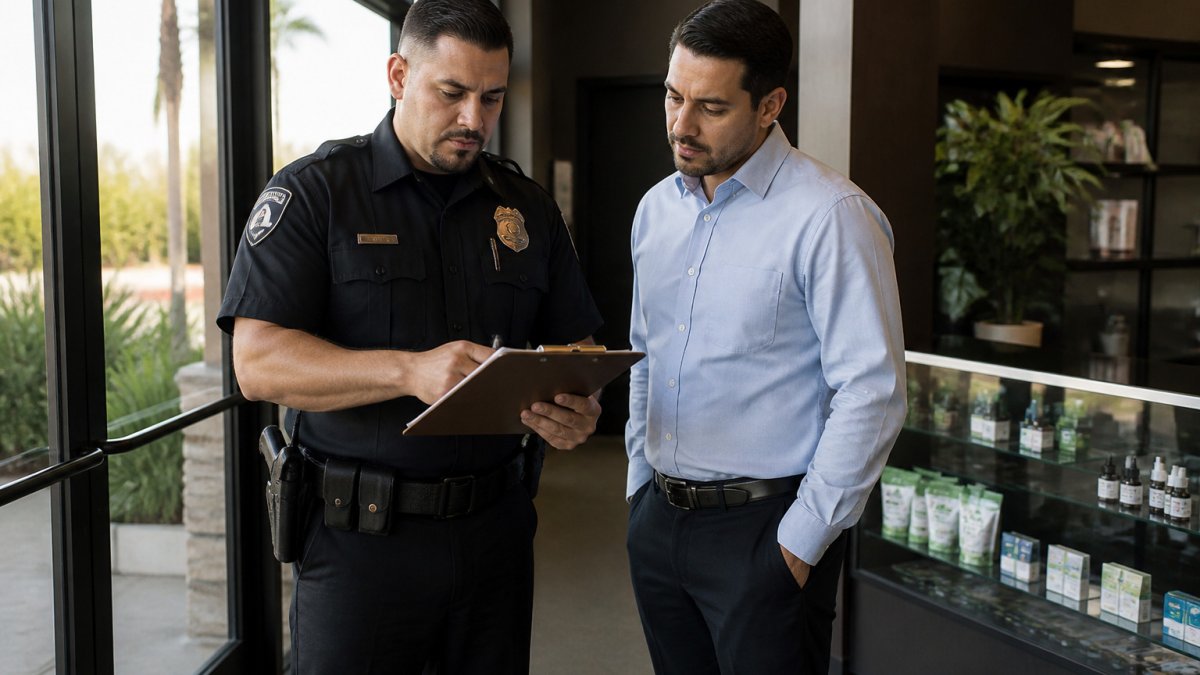
Most guides stop at "verify the Guard Card." For a dispensary, the checklist that actually protects you ties licensing to insurance, equipment and written post orders. Learn how to vet security guard companies before you sign. Use it to vet a provider or in-house hires.
Licensing and Credential Verification
A common failure pattern: the company is licensed, the officer has a Guard Card, but the exposed firearm permit is expired or was never issued. That single gap turns an armed post into an unlicensed armed post.
Insurance and Liability Coverage, The Part Most Guides Skip
Your own property and business policy may also contain security-related conditions, required guard coverage during certain hours or specified loss-prevention measures. Review those with your broker before finalizing a security contract, because a condition you fail to meet can reduce or void a claim.
Equipment and Gear Standards
Put equipment standards in the contract, expectations that live only in a verbal agreement tend to disappear when an officer is reassigned.
Written Post Orders and Incident Reporting
A provider that cannot produce written post orders for a dispensary site is improvising, exactly what you do not want at a cash-handling door.
Booking Armed Coverage for Your Dispensary
Securify Security Services offers armed, unarmed and vehicle patrol services with customizable security solutions. Our officers undergo rigorous background checks and intensive training, and our team is Licensed & Insured under PPO#122535. Contact us for a free quote.
Frequently Asked Questions
What license does an armed security guard need in California?
An armed security guard in California needs a valid Guard Card issued by the Bureau of Security and Investigative Services (BSIS). Applicants must be at least 18, pass a background check through Live Scan fingerprinting, and complete the required training. To carry a firearm on duty, the guard also needs a separate BSIS exposed firearm permit. Dispensaries should confirm both credentials are current before assigning an officer to an armed post.
Can a cannabis dispensary hire an armed security guard in California?
Yes. Dispensaries in California can hire armed security guards, but the guard must hold a valid BSIS Guard Card and a firearm permit that authorizes armed duty. Many dispensaries use licensed private patrol operators rather than hiring armed staff directly. Either way, the business should verify the license status of every armed officer and keep records of training, permits and background clearances on file.
What should a dispensary verify before hiring an armed guard?
Verify that the guard's BSIS Guard Card is active and not expired, and that the exposed firearm permit is current. Confirm the background check and fingerprint clearance, check the training certificates, and ask whether the officer has liability coverage through the security company. Review incident-handling experience and ask for references from similar high-risk properties.
What is the difference between armed and unarmed guards for dispensaries?
Armed guards carry a firearm under a BSIS exposed firearm permit and typically cover higher-risk posts such as cash handling, transport or perimeter protection. Unarmed guards focus on access control, surveillance monitoring, patrol and incident reporting. Many dispensaries use a mix, with armed coverage at the points where a firearm presence is most useful.
How can a dispensary check whether a security guard's license is active?
Ask the guard for their BSIS license number and look it up through the Bureau of Security and Investigative Services online license search. The record shows the license type, status and expiration date. Re-check periodically, since licenses can lapse or be revoked, and keep a copy of the verification with your vendor documentation.